Religion
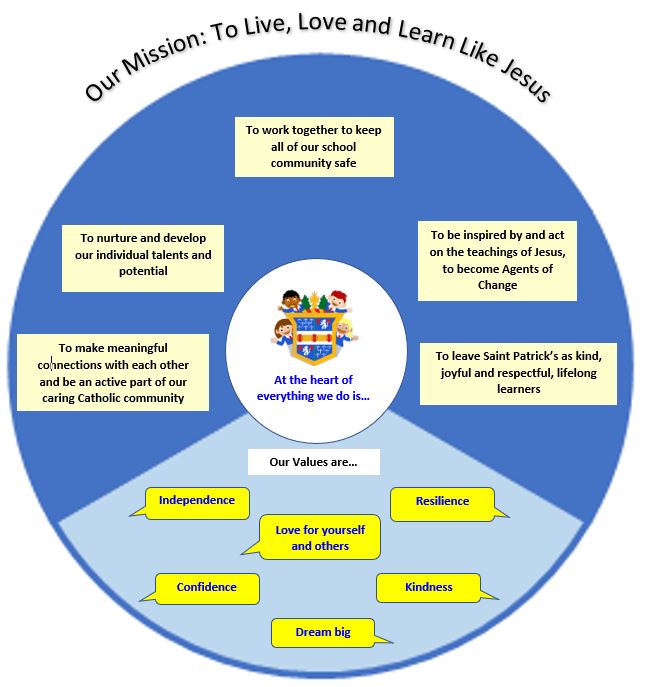
Our mission in Saint Patrick’s is to develop each child’s talents and potential in a caring Catholic community inspired by the teachings of Jesus Christ.
‘LIVE, LOVE AND LEARN LIKE JESUS’
(Pupils’ translation of the Mission Statement)
The Mission statement is central to everything that we do at Saint Patrick's Catholic Primary. It is our starting point for creating policy and procedure, as well as informing whole school strategy and Curriculum planning.
At Saint Patrick’s it is important that we care for, listen and respond to the views of all of our community; parents, children, staff, parishioners.
In July 2023 we invited all of these people to join us and revisit our mission statement, to celebrate all we do. We then asked the Chaplaincy Team for their thoughts and opinions too. Finally, our governors shared their ideas.
This means that together we have created a new way of looking at our Mission Statement to show how special all at Saint Patrick’s are.
We have decided to keep ‘Live, Love and Learn Like Jesus’ as we believe this is a true reflection of life at our school and what we want to achieve.
We have however, added further detail to make it really clear what our mission is:
Intent
At our Catholic school, Religious Education lies at the heart of our curriculum. Guided by the Religious Education Directory (R.E.D): To Know You More Clearly, our intent is to enable every child to grow in knowledge, understanding and relationship with God, while developing a deep appreciation of the teachings and traditions of the Catholic Church.
We aim for our pupils to:
- Develop a secure and progressive understanding of the core narrative of Christian history through the key branches of study: Creation, Prophecy and Promise, Galilee to Jerusalem, Desert to Garden, To the Ends of the Earth, and Dialogue and Encounter
- Grow spiritually and morally, recognising their dignity as individuals created and loved by God
- Engage thoughtfully with questions of meaning, purpose and belief
- Understand and live out Catholic Social Teaching, including care for creation, dignity of the human person and the call to community
- Develop respect for other faiths and cultures through meaningful dialogue and encounter
Our curriculum nurtures the whole child—intellectually, spiritually and emotionally—so that pupils are able to live their faith with confidence, compassion and responsibility in the modern world.
Implementation
Religious Education is delivered through a carefully structured, progressive curriculum based on the R.E.D model, ensuring clear progression from EYFS to Year 6.
-
Learning is organised into the six core curriculum branches across the year:
- Creation
- Prophecy and Promise
- Galilee to Jerusalem
- Desert to Garden
- To the Ends of the Earth
- Dialogue and Encounter
Each unit builds pupils’ knowledge through:
-
- Scripture study and engagement with Biblical texts
- Exploration of Church teaching and tradition
- Opportunities for reflection, discussion and personal response
RE is at the centre of school life and is enriched through:
- A rich programme of Prayer and Liturgy, including Masses, Feast Days, the Rosary, Reconciliation and Stations of the Cross, embedded within the liturgical year
- Strong links to Catholic Social Teaching, explored through themes such as:
- Care for Creation
- Dignity of Work
- Preferential Option for the Poor
- Solidarity
- Rights and Responsibilities
- Life and Dignity
- Common Good
- Integration with RHE (Life to the Full), supporting pupils in understanding relationships, dignity and vocation as part of God’s plan
- Opportunities for pupil leadership, including chaplaincy roles and involvement in collective worship
- Cross-curricular links and whole-school celebrations that deepen understanding of faith in action
Pupils are given regular opportunities to reflect, respond and evaluate, developing both their religious literacy and their ability to think critically and respectfully about belief.
Impact
The impact of our Religious Education curriculum is that pupils leave our school as:
- Religiously literate young people, with a secure knowledge of Scripture, Church teaching and the Catholic tradition
- Individuals who understand their identity as children of God, with a strong sense of dignity, self-worth and purpose
- Compassionate and responsible citizens who actively live out Catholic Social Teaching in their actions
- Confident communicators, able to discuss, reflect and evaluate beliefs thoughtfully and respectfully
- Pupils who value prayer, reflection and worship as meaningful parts of their own and others' lives
Children demonstrate:
- A clear understanding of the story of Christian history and its relevance today
- The ability to make links between faith, life and moral decision-making
- Respect and openness towards other faiths and worldviews, particularly through Dialogue and Encounter learning
By the end of Year 6, our pupils are well-prepared for the next stage of their education, equipped not only with knowledge and skills but with a strong foundation of faith, values and spiritual awareness, enabling them to contribute positively to society.